A Market Shift Dealers Can't Ignore
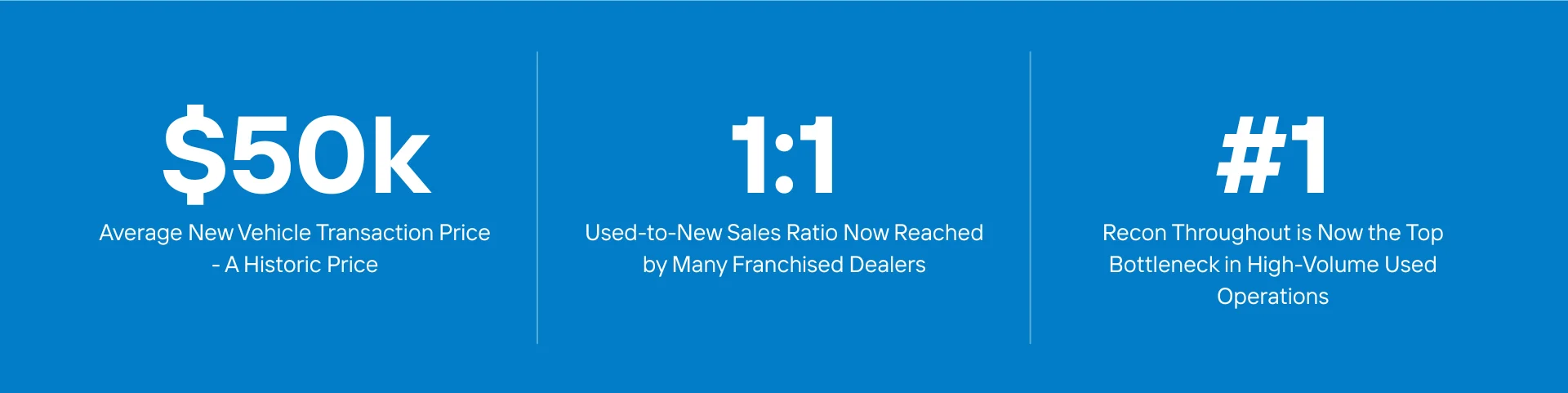
For the first time in automotive retail history, the average transaction price for a new vehicle has crossed $50,000. According to Cox Automotive and Kelley Blue Book's market reporting, new vehicle affordability has reached a tipping point — and buyers are responding by turning to the used market in record numbers.
The numbers tell a clear story: many franchised new car dealers have now hit or surpassed a 1-to-1 ratio of used-to-new vehicle sales. That means for every new car rolling off the lot, an equal number of used vehicles are moving too. For dealers who got into this business primarily as new car retailers, that's a fundamental shift in how their stores operate day to day.
"Every day a used vehicle sits in reconditioning is a day it isn't generating revenue on your lot."
The dealers who are winning in this environment aren't necessarily the ones with the biggest new car inventory. They're the ones who have invested in their ability to move used vehicles quickly, efficiently, and profitably. And the critical path to doing that runs straight through your reconditioning department.
Why Reconditioning Is Your Competitive Edge
Used car gross profit is directly tied to two things: the price you can command for a well-presented vehicle, and the cost it takes to get it there. Reconditioning sits at the intersection of both. Faster recon means faster turn. Faster turn means more volume. More volume at controlled cost means better margins.
According to NADA's Annual Dealer Financial Profile, detail and reconditioning labor is consistently one of the highest-margin internal operations a dealership runs. Yet it's also the area where dealers most frequently find themselves capacity-constrained — and where sublet costs quietly erode profitability when the right equipment isn't in place.
The good news? The right equipment investment pays for itself quickly in sublet savings alone — before you even account for the turn-time improvements.
Equipment That Moves the Needle
Here's a practical look at the equipment categories that have the highest impact on reconditioning throughput and cost control:
Brakes & Tires
- On-Vehicle Brake Lathes - Every used vehicle needs a brake inspection — and many need service. Handling this in-house eliminates sublet costs and keeps the recon process moving. The ROI case is straightforward and fast.
- Tire Changers & Balancers - Higher used car volume means more tires being assessed, swapped, and balanced. If your shop is running lean on capacity here, tires become a bottleneck that backs up your entire recon lane.
Detail & Wash
- Pressure Washers - The detail process starts at the wash bay. High-volume recon demands reliable, high-output equipment — cutting corners here slows the entire downstream process.
- Centralized Vacuum Systems - Dealers expanding detail throughput need efficiency at scale. Central vac systems eliminate the time wasted managing portable units across multiple bays and deliver consistent results.
- Additional Detail Bays - For many dealers, the detail department is the single biggest recon bottleneck. Adding bay capacity is one of the highest-return investments a high-volume used car operation can make.
Shop Capacity & Infrastructure
- Alignment Machines - Used cars — especially auction units and high-mileage trades — frequently need alignments. Every alignment subleted out is margin walking out the door.
- Vehicle Lifts (2-Post & 4-Post) - More cars in recon means more cars needing to be in the air simultaneously. Lift capacity is often the first constraint a growing used car operation hits.
- Fluid Exchange Equipment - Transmission services, coolant exchanges, and brake fluid replacements are common recon line items that many dealers still sublet unnecessarily. Bring them in-house and keep the margin.
- Air Compressor Capacity - Running more equipment simultaneously puts more demand on your compressed air system. Many shops are undersized and don't realize it — it's a quiet drag on every bay's efficiency.
- Parts Washers - Brake and suspension component cleaning is time-consuming without the right setup. Aqueous parts washers speed up technician time and keep bays cleaner and safer.
Think Beyond the Equipment List
The most successful dealers we work with don't just buy equipment — they think about reconditioning as a profit center with measurable throughput metrics. If you're not currently tracking cost-per-vehicle-reconditioned and average days-to-frontline, those two numbers are the place to start.
Once you know your baseline, every equipment investment becomes a straightforward ROI conversation: How many vehicles per week can we add? How many sublet dollars can we recover? How many days can we cut from average recon time? Those answers determine your payback period — and in the current market, that payback is happening faster than ever.
Quick Wins: In House vs. Sublet
Bringing these services in-house typically delivers the fastest ROI in a high-volume used car operation:
- Brake service & rotor resurfacing
- Tire changes & balancing
- Wheel alignments
- Fluid exchanges
- Suspension component cleaning
Two Metrics to Track Now
If you're not measuring these, start today:
- Cost per vehicle reconditioned
- Average days to frontline (recon to lot-ready)
Sources
- Cox Automotive / Kelley Blue Book — Average new vehicle transaction pricing reports (coxautoinc.com)
- NADA — Annual Dealer Financial Profile (nada.org)
- Black Book / Manheim Market Report — Used vehicle volume and pricing trends