Should My Shop Invest in ADAS Calibrations?
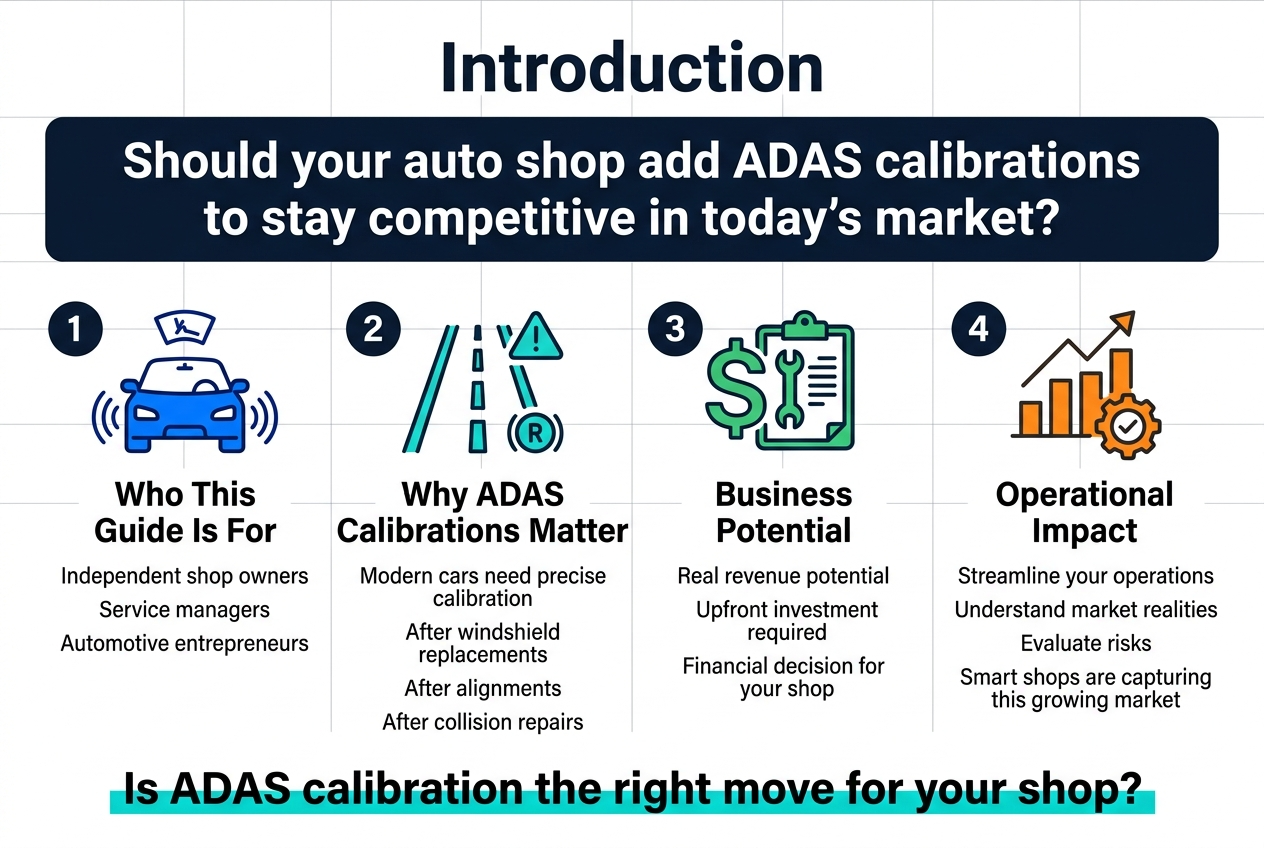
This question keeps many shop owners up at night as vehicles get smarter and traditional repair work evolves.
This guide is for independent shop owners, service managers, and automotive entrepreneurs trying to decide if ADAS calibration services make financial sense for their business. Modern cars packed with safety features like lane departure warnings and automatic emergency braking need precise calibration after windshield replacements, alignments, and collision repairs.
We'll break down the real revenue potential from offering ADAS calibrations and what you actually need to invest upfront. You'll also discover how these services can streamline your operations while we examine the risks and market realities that could impact your decision.
Smart shops are already capturing this growing market - but is it right for yours?
Understanding ADAS Technology and Market Demand
What ADAS Systems Are and How They Work in Modern Vehicles
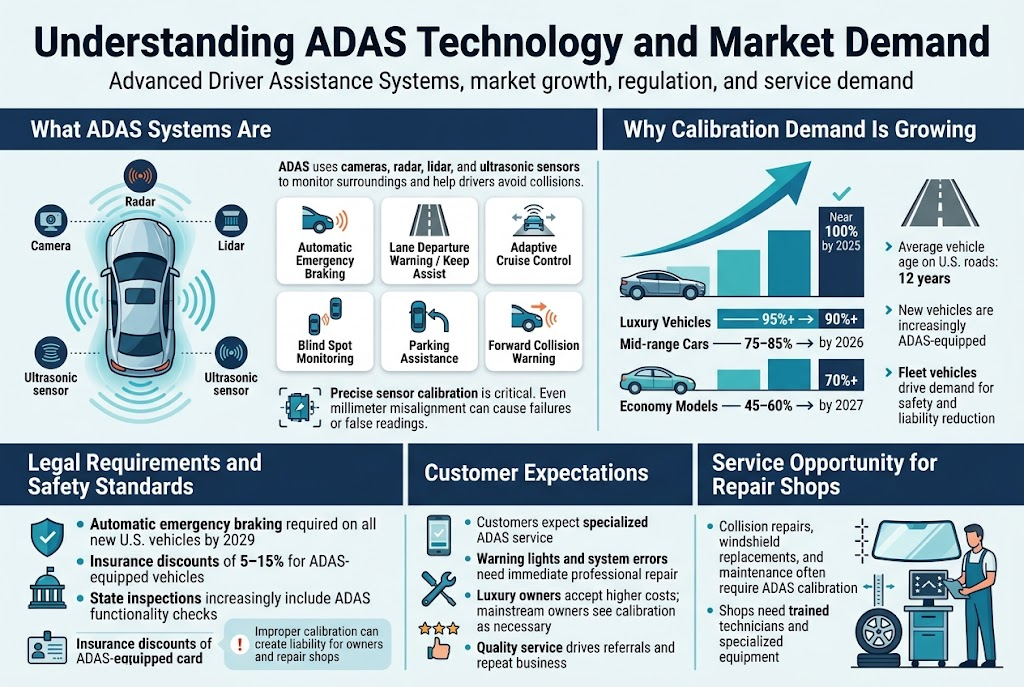
Advanced Driver Assistance Systems represent a collection of safety technologies that help drivers avoid collisions and navigate safely. These systems use cameras, radar sensors, lidar, and ultrasonic sensors to monitor the vehicle's surroundings and provide real-time assistance.
Common ADAS features include:
- Automatic Emergency Braking (AEB) - Detects potential collisions and applies brakes automatically
- Lane Departure Warning/Keep Assist - Monitors lane markings and alerts or corrects steering
- Adaptive Cruise Control - Maintains safe following distance from vehicles ahead
- Blind Spot Monitoring - Alerts drivers to vehicles in adjacent lanes
- Parking Assistance - Helps with parallel and perpendicular parking maneuvers
- Forward Collision Warning - Provides early alerts about potential frontal impacts
These systems rely on precise sensor calibration to function correctly. When sensors are misaligned even by millimeters, the entire system can fail or provide false readings. This creates the need for specialized calibration equipment and trained technicians whenever collision repairs, windshield replacements, or certain maintenance procedures are performed.
Growing Prevalence of ADAS-Equipped Vehicles on the Road
The automotive landscape has shifted dramatically over the past decade. What once was luxury technology has become standard equipment across most vehicle segments. Major automakers now include multiple ADAS features as standard equipment, even on entry-level models.
Recent industry data shows impressive growth trends:
| Vehicle Category | ADAS Penetration Rate | Expected Growth |
| Luxury Vehicles | 95%+ | Near 100% by 2025 |
| Mid-range Cars | 75-85% | 90%+ by 2026 |
| Economy Models | 45-60% | 70%+ by 2027 |
The average vehicle age on American roads is approximately 12 years, meaning shops will continue seeing both ADAS-equipped and non-equipped vehicles for years to come. However, newer vehicles entering the market almost universally include these systems, creating an expanding customer base requiring specialized calibration services.
Fleet vehicles represent another significant opportunity, as commercial operators prioritize safety features to reduce liability and insurance costs. Many fleet managers specifically choose ADAS-equipped vehicles to protect their drivers and minimize accident-related expenses.
Legal Requirements and Safety Standards Driving Adoption
Regulatory pressure continues pushing ADAS adoption across the industry. The National Highway Traffic Safety Administration (NHTSA) has established requirements for automatic emergency braking on all new vehicles sold in the United States by 2029. Similar mandates exist for backup cameras and are expanding to include additional safety systems.
Insurance companies actively encourage ADAS adoption through premium discounts for equipped vehicles. Some insurers offer reductions of 5-15% for vehicles with comprehensive safety packages. This financial incentive motivates consumers to choose ADAS-equipped vehicles and maintain these systems properly.
State safety inspection programs increasingly include ADAS functionality checks. Several states have begun requiring verification that safety systems operate correctly during annual inspections. This regulatory trend creates additional touchpoints where calibration services become necessary.
Liability concerns also drive proper ADAS maintenance. If an accident occurs and investigation reveals improperly calibrated safety systems, both vehicle owners and repair shops could face legal consequences. This reality motivates shops to invest in proper calibration equipment and training.
Customer Expectations for Professional ADAS Services
Today's vehicle owners understand their cars contain sophisticated technology requiring specialized care. They expect repair shops to maintain ADAS systems with the same precision used for other critical vehicle components. Customers often research shops specifically looking for ADAS calibration capabilities before choosing where to have work performed.
Mobile device dependency has shaped customer expectations around technology reliability. Just as people expect their smartphones to work flawlessly, drivers expect their vehicle safety systems to function perfectly every time. When ADAS warning lights appear or systems behave erratically, customers seek immediate professional resolution.
Price sensitivity varies among customer segments. Luxury vehicle owners typically accept higher costs for specialized services, understanding their vehicles require advanced equipment and training. However, mainstream vehicle owners increasingly recognize ADAS calibration as necessary rather than optional, especially after collision repairs or windshield replacement.
Word-of-mouth referrals carry significant weight in this market. Customers who receive quality ADAS services often become strong advocates, referring friends and family members who own similar vehicles. Conversely, shops unable to provide these services may lose customers to competitors offering comprehensive ADAS capabilities.
The growing awareness of ADAS technology creates opportunities for shops to educate customers about calibration needs and build trust through transparent communication about required services and associated costs.
Revenue Opportunities from ADAS Calibration Services
Premium pricing potential for specialized calibration work
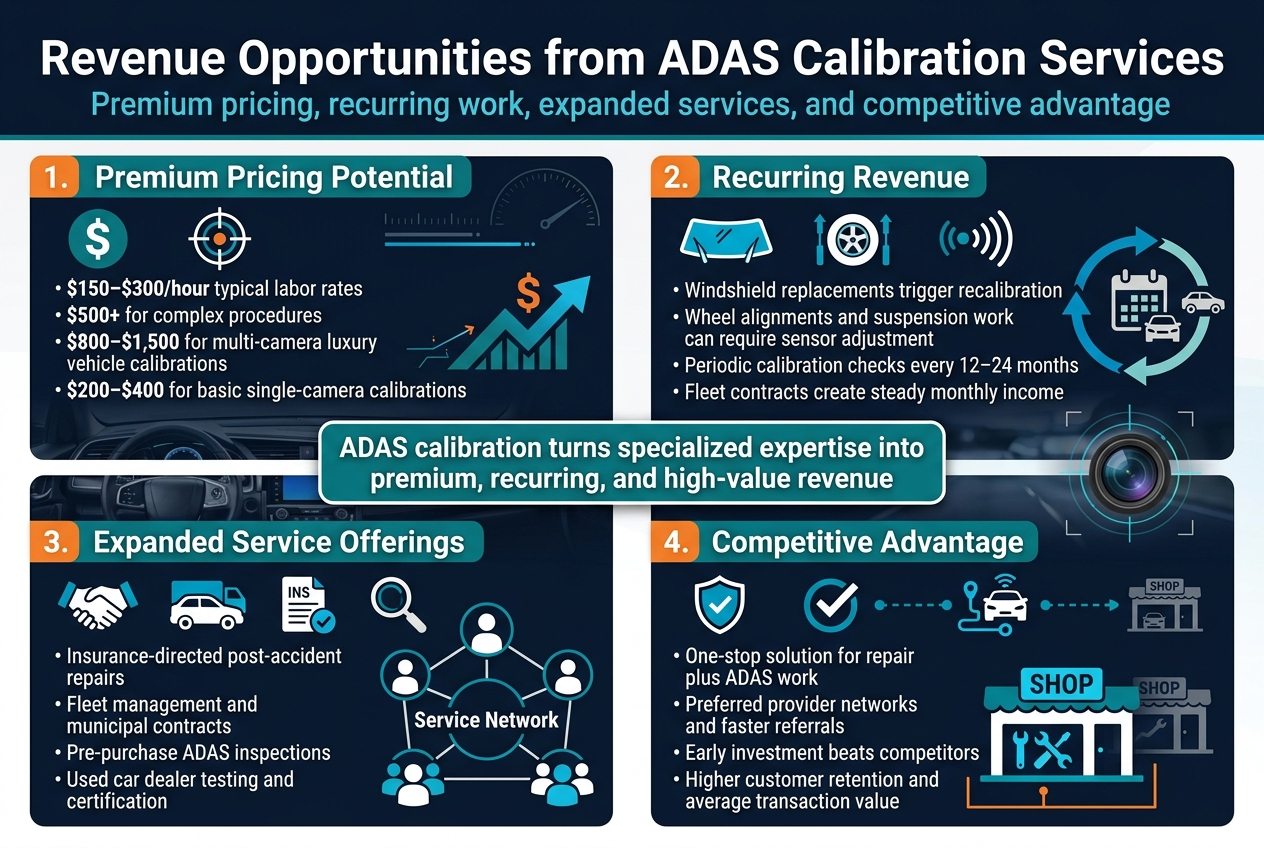
ADAS calibration services command significantly higher labor rates compared to traditional automotive repairs. While standard brake jobs or oil changes operate on competitive pricing models, ADAS work falls into the specialty category where customers expect to pay premium rates. Most shops charge between $150-$300 per hour for calibration services, with some complex procedures reaching $500 or more.
The specialized nature of this work justifies these rates. Customers understand they're paying for advanced diagnostic equipment, specialized training, and precise technical expertise. Unlike commodity services where price shopping is common, vehicle owners typically prioritize accuracy and reliability when their safety systems need attention.
Multi-camera calibrations on luxury vehicles can generate $800-$1,500 in revenue per service visit. Even basic single-camera calibrations typically bring in $200-$400, representing substantial profit margins when performed efficiently. Insurance companies also recognize these legitimate costs, making payment disputes less common than with traditional bodywork.
Recurring revenue from regular maintenance and recalibration needs
ADAS systems require recalibration after various maintenance events, creating predictable revenue streams. Windshield replacements trigger mandatory camera recalibrations. Wheel alignments on vehicles with lane-keeping assist often require sensor adjustments. Even routine suspension work can affect radar positioning.
Weather and road conditions gradually affect sensor accuracy over time. Many manufacturers recommend periodic calibration checks, typically every 12-24 months, depending on driving conditions and vehicle age. This creates ongoing customer relationships rather than one-time transactions.
Fleet customers represent particularly valuable recurring revenue opportunities. Commercial vehicles, delivery fleets, and rental car companies need regular ADAS maintenance across dozens or hundreds of vehicles. These contracts provide steady monthly income and help smooth out seasonal fluctuations in repair volume.
Expanded service offerings beyond basic automotive repair
ADAS capabilities open doors to entirely new customer segments. Insurance companies increasingly direct customers to certified ADAS shops for post-accident repairs, expanding your potential customer base beyond walk-in traffic and regular maintenance clients.
Fleet management companies seek partners who can handle both traditional mechanical work and advanced electronics. Government agencies and municipal fleets often require ADAS-certified providers for contract eligibility. These B2B relationships typically involve higher-volume work and more predictable payment terms.
Pre-purchase inspections gain new revenue potential when shops can verify ADAS functionality. Used car dealers pay premium rates for comprehensive ADAS testing before putting vehicles on their lots. This service helps differentiate your inspection offerings from basic safety checks.
Competitive advantage over shops without ADAS capabilities
Shops with ADAS calibration capabilities capture customers that competitors must turn away. When a customer needs both traditional repair work and ADAS services, they prefer one-stop solutions. This convenience factor builds customer loyalty and increases average transaction values.
Insurance partnerships favor shops with comprehensive capabilities. Many insurers maintain preferred provider networks that prioritize facilities offering complete collision and mechanical repair services, including ADAS work. These partnerships provide steady referral volume and faster payment processing.
The growing complexity of modern vehicles means ADAS capabilities become increasingly essential rather than optional. Shops without these services find themselves excluded from more repair jobs each year. Early investment in ADAS equipment positions your business ahead of competitors who delay this transition.
Customer retention improves when shops can handle complete vehicle needs. Rather than referring ADAS work to competitors, you keep the entire relationship in-house, building stronger customer connections and preventing potential service defection.
Initial Investment Requirements and Costs
Equipment Costs for Calibration Tools and Diagnostic Systems
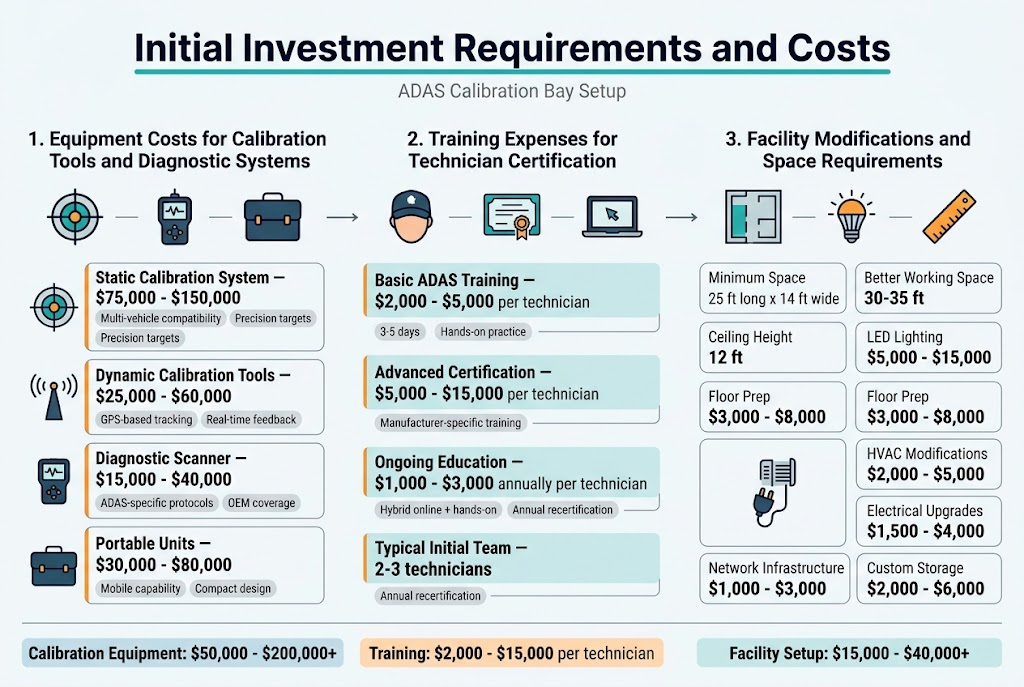
Setting up an ADAS calibration bay requires a significant upfront investment in specialized equipment. The cornerstone of any operation is a comprehensive calibration system, which typically ranges from $75,000 to $150,000 for a complete setup. This includes static calibration boards, dynamic calibration tools, and mounting hardware designed for various vehicle makes and models.
Multi-brand calibration systems from manufacturers like Hunter, Autel, or Launch offer the versatility needed to service different vehicle types. These systems come with vehicle-specific adapters, target boards for camera calibration, and radar calibration tools. Basic systems start around $50,000, while premium setups with advanced features can reach $200,000 or more.
Diagnostic equipment represents another substantial cost. High-end scan tools capable of ADAS diagnostics range from $15,000 to $40,000. These tools must support multiple communication protocols and provide real-time data streaming for proper system validation.
Additional equipment includes wheel alignment systems (if not already owned), laser measuring devices for precise positioning, and specialized lifts or alignment racks. Many shops also invest in portable calibration units, which cost $30,000 to $80,000 but offer flexibility for mobile services.
| Equipment Category | Price Range | Essential Features |
| Static Calibration System | $75,000 - $150,000 | Multi-vehicle compatibility, precision targets |
| Dynamic Calibration Tools | $25,000 - $60,000 | GPS-based tracking, real-time feedback |
| Diagnostic Scanner | $15,000 - $40,000 | ADAS-specific protocols, OEM coverage |
| Portable Units | $30,000 - $80,000 | Mobile capability, compact design |
Training Expenses for Technician Certification
Proper technician training is non-negotiable for ADAS calibration success. Manufacturers require certified technicians to maintain warranty compliance, and insurance companies increasingly demand proof of proper training. Training costs vary widely based on the depth of education and certification level pursued.
Basic ADAS training courses run $2,000 to $5,000 per technician and cover fundamental concepts, safety procedures, and equipment operation. These introductory programs typically last 3-5 days and provide hands-on experience with calibration procedures.
Advanced certification programs cost $5,000 to $15,000 per technician and include manufacturer-specific training for premium brands like BMW, Mercedes-Benz, or Tesla. These intensive programs often require travel to training facilities, adding accommodation and travel expenses to the total cost.
Online training components have become more prevalent, reducing some costs while maintaining quality education. Hybrid programs combining online theory with hands-on practice offer cost-effective solutions for shops with multiple technicians.
Ongoing education represents a continuous expense. ADAS technology evolves rapidly, requiring annual recertification and updates on new vehicle systems. Budget $1,000 to $3,000 annually per technician for continuing education to stay current with industry standards.
Many shops find that training 2-3 technicians initially provides adequate coverage while building expertise gradually. This approach spreads the training investment over time and ensures service continuity when technicians are unavailable.
Facility Modifications and Space Requirements
ADAS calibration demands specific facility requirements that many shops don't currently meet. The calibration bay needs adequate space, proper lighting, and environmental controls to ensure accurate measurements and consistent results.
Minimum space requirements call for a bay at least 25 feet long and 14 feet wide, though 30-35 feet provides better working conditions. The space must accommodate the vehicle, calibration equipment, and technician movement. Height requirements vary by equipment type, but 12-foot ceilings are typically sufficient.
Lighting modifications represent a significant expense for most shops. ADAS calibration requires consistent, shadow-free illumination with specific color temperature characteristics. LED lighting systems designed for calibration bays cost $5,000 to $15,000, depending on bay size and existing electrical infrastructure.
Floor preparation is often overlooked but critical for accuracy. The calibration area needs a level, stable surface marked with reference points for equipment positioning. Professional floor marking and leveling can cost $3,000 to $8,000, while some shops invest in specialized calibration floor systems costing $15,000 or more.
Environmental controls help maintain consistent conditions for sensitive equipment. HVAC modifications to minimize air movement and temperature fluctuations may require $2,000 to $5,000 in additional investment.
Electrical upgrades frequently accompany facility modifications. ADAS equipment requires dedicated circuits and adequate power distribution, potentially adding $1,500 to $4,000 to the renovation budget. Network infrastructure for equipment connectivity and software updates represents another $1,000 to $3,000 expense.
Storage solutions for calibration targets and equipment protect valuable assets while maintaining organization. Custom storage systems range from $2,000 to $6,000, depending on equipment inventory and space constraints.
Operational Benefits and Efficiency Gains
Streamlined workflow integration with existing services
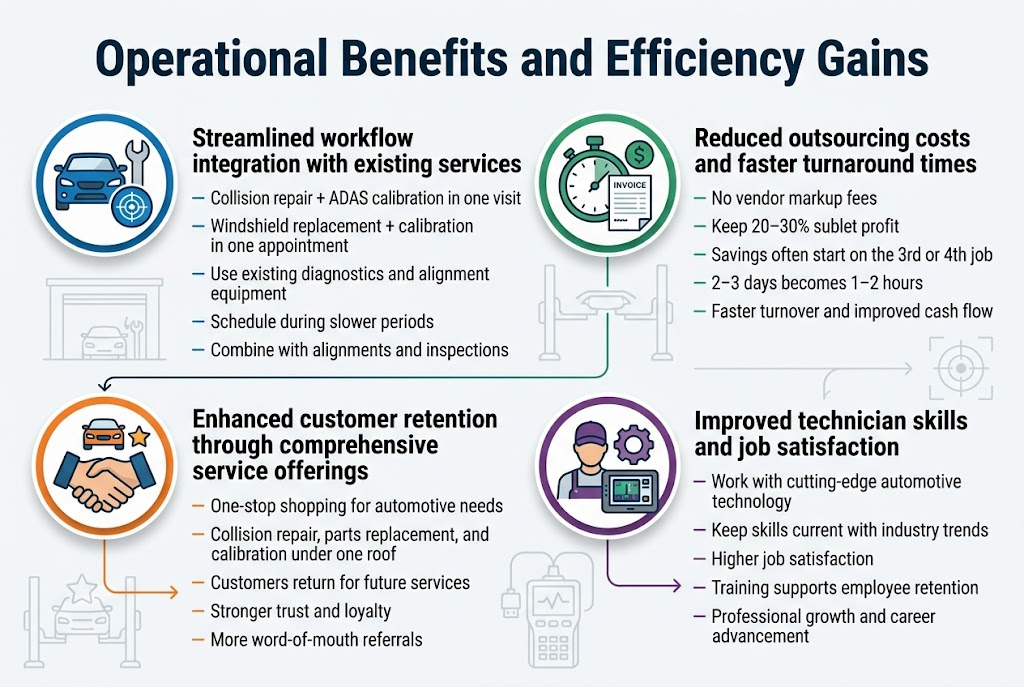
Adding ADAS calibration services creates natural synergies with your current repair operations. When a customer brings in a vehicle for collision repair or windshield replacement, you can immediately perform the necessary calibration work instead of sending them elsewhere. This seamless integration means one appointment handles multiple services, saving both you and your customer valuable time.
The equipment setup works well alongside existing diagnostic tools and alignment equipment. Many shops find they can schedule ADAS calibrations during slower periods or combine them with other services like alignments or inspections. This flexibility helps maximize equipment usage and keeps technicians productive throughout the day.
Reduced outsourcing costs and faster turnaround times
Running your own ADAS calibrations eliminates the markup fees you typically pay to outside vendors. Instead of adding 20-30% to sublet work, you keep that profit margin while offering competitive pricing to customers. The math works out favorably - most shops see immediate savings on their third or fourth calibration job.
Customer wait times drop significantly when you handle calibrations in-house. What used to take 2-3 days with scheduling and transport to another facility now takes 1-2 hours in your bay. Faster service means happier customers and quicker vehicle turnover, improving your cash flow and shop efficiency.
Enhanced customer retention through comprehensive service offerings
Customers appreciate one-stop shopping for their automotive needs. When you can handle their collision repair, parts replacement, and safety system calibration all under one roof, they're more likely to return for future services. This builds stronger relationships and increases customer lifetime value.
Your shop becomes their trusted automotive partner rather than just another repair option. Word-of-mouth referrals increase when customers can confidently recommend a shop that handles everything professionally and efficiently.
Improved technician skills and job satisfaction
ADAS calibration work challenges technicians with cutting-edge automotive technology, keeping their skills current with industry trends. This technical growth makes your team more valuable and engaged in their work. Technicians often report higher job satisfaction when they're working with advanced systems rather than routine maintenance tasks.
Training opportunities in ADAS technology also help with employee retention. Skilled technicians want to work somewhere they can learn new technologies and advance their careers. Offering this training shows your investment in their professional development.
Risk Assessment and Market Considerations
Liability Concerns and Insurance Implications
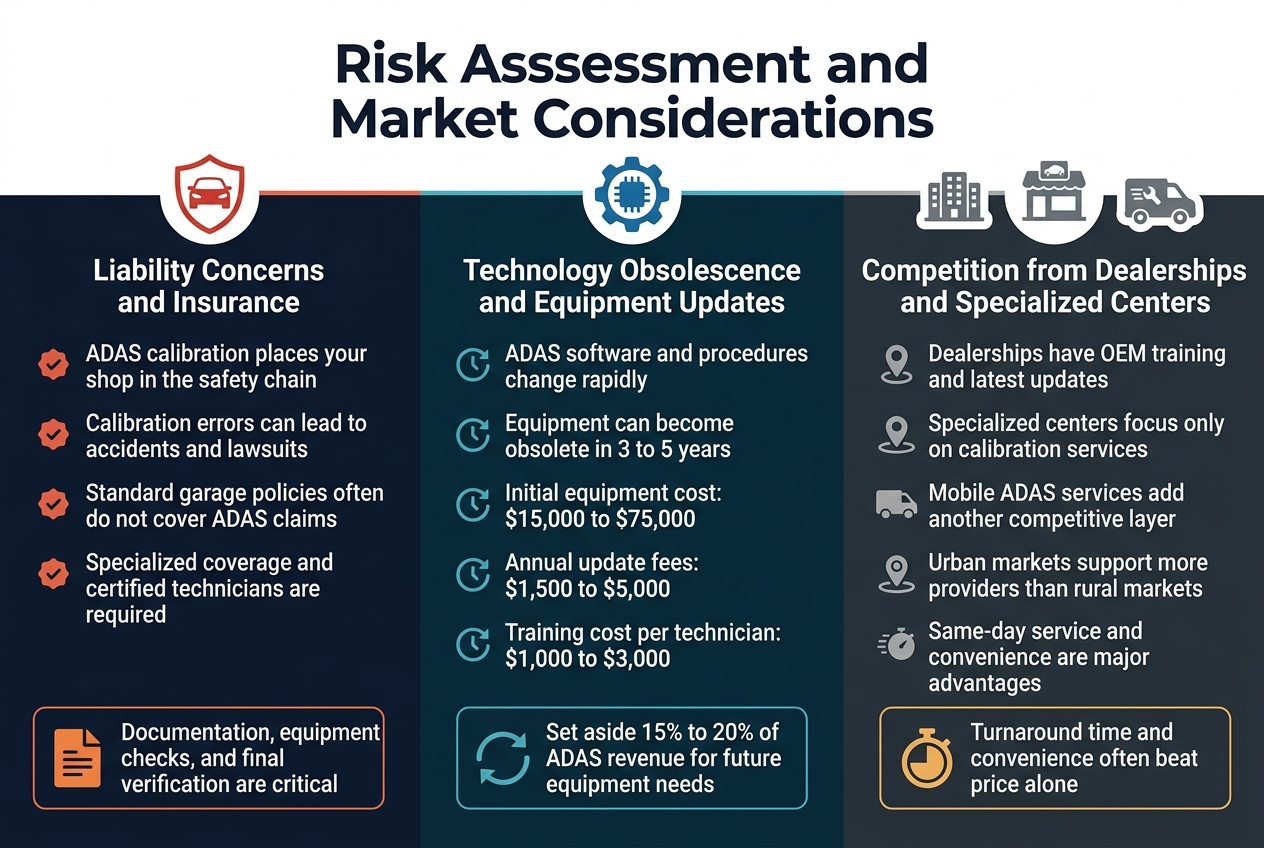
Running an ADAS calibration service puts your shop directly in the safety chain of advanced driver assistance systems. When you calibrate a forward collision warning system or lane departure alert, you're essentially vouching that these safety features will work correctly. If a calibration error leads to system failure and an accident occurs, your shop could face significant liability exposure.
Most standard garage liability policies don't automatically cover ADAS-related claims. You'll need specialized coverage that addresses calibration errors, software issues, and potential safety system failures. This additional insurance can cost anywhere from $2,000 to $8,000 annually, depending on your coverage limits and claims history.
Documentation becomes absolutely critical. Every calibration requires detailed records showing proper procedures, equipment functionality checks, and final system verification. Insurance carriers often require specific training certifications for technicians performing ADAS work. Without proper documentation and certified staff, claims could be denied, leaving your business exposed to potentially devastating lawsuits.
Some shops partner with specialized ADAS service providers to reduce liability exposure while still offering calibration services to customers. This approach shifts primary liability to the specialized provider while allowing your shop to maintain customer relationships and earn referral fees.
Technology Obsolescence and Equipment Update Requirements
ADAS technology evolves rapidly, with automakers constantly updating software protocols and introducing new systems. The diagnostic equipment and calibration targets you purchase today might become obsolete within 3-5 years. Major equipment manufacturers typically release significant updates annually, with some requiring complete hardware replacements.
Budget planning becomes challenging when equipment costs $15,000-$75,000 initially, plus ongoing update fees ranging from $1,500-$5,000 per year. Software licensing often follows subscription models, adding monthly costs that can reach $200-$500 depending on vehicle coverage. Missing updates means losing the ability to service newer vehicles, potentially cutting your addressable market in half within just two years.
Vehicle manufacturers frequently change calibration procedures and requirements through technical service bulletins. What worked for a 2022 model might be completely different for the 2024 version of the same vehicle. Staying current requires continuous training investments, typically $1,000-$3,000 per technician annually.
Some equipment manufacturers offer trade-in programs or upgrade paths, but these still require significant capital outlays every few years. Smart shops factor technology refresh costs into their pricing models from day one, setting aside 15-20% of ADAS revenue for future equipment needs.
Competition from Dealerships and Specialized ADAS Centers
Dealerships hold significant advantages in the ADAS market. They have direct access to manufacturer training, latest software updates, and OEM-specific procedures. Many offer ADAS calibration as a loss leader to drive service department traffic, making it difficult for independent shops to compete on price alone.
Specialized ADAS centers are emerging in major markets, focusing exclusively on calibration services. These facilities often serve multiple independent shops, offering wholesale pricing that undercuts individual shop investments. Mobile ADAS services add another competitive layer, bringing calibration equipment directly to other shops or customer locations.
Geographic market size plays a huge role in competition dynamics. Urban areas might support multiple ADAS providers, while rural markets might barely sustain one. Before investing, analyze your local market carefully. How many dealerships offer ADAS services? Are there existing specialized centers? What's the nearest mobile service coverage area?
Customer loyalty and convenience often outweigh price considerations in ADAS services. Many car owners prefer having all their service work done at one location rather than visiting separate facilities for different needs. This gives established independent shops a competitive edge over specialized centers, provided they can match service quality and pricing.
The key differentiator often comes down to turnaround time and convenience. Dealerships might require appointments weeks out, while specialized centers might not offer other automotive services. Independent shops that can provide same-day ADAS calibration alongside routine maintenance and repairs often capture the most valuable customer relationships.
In Conclusion:
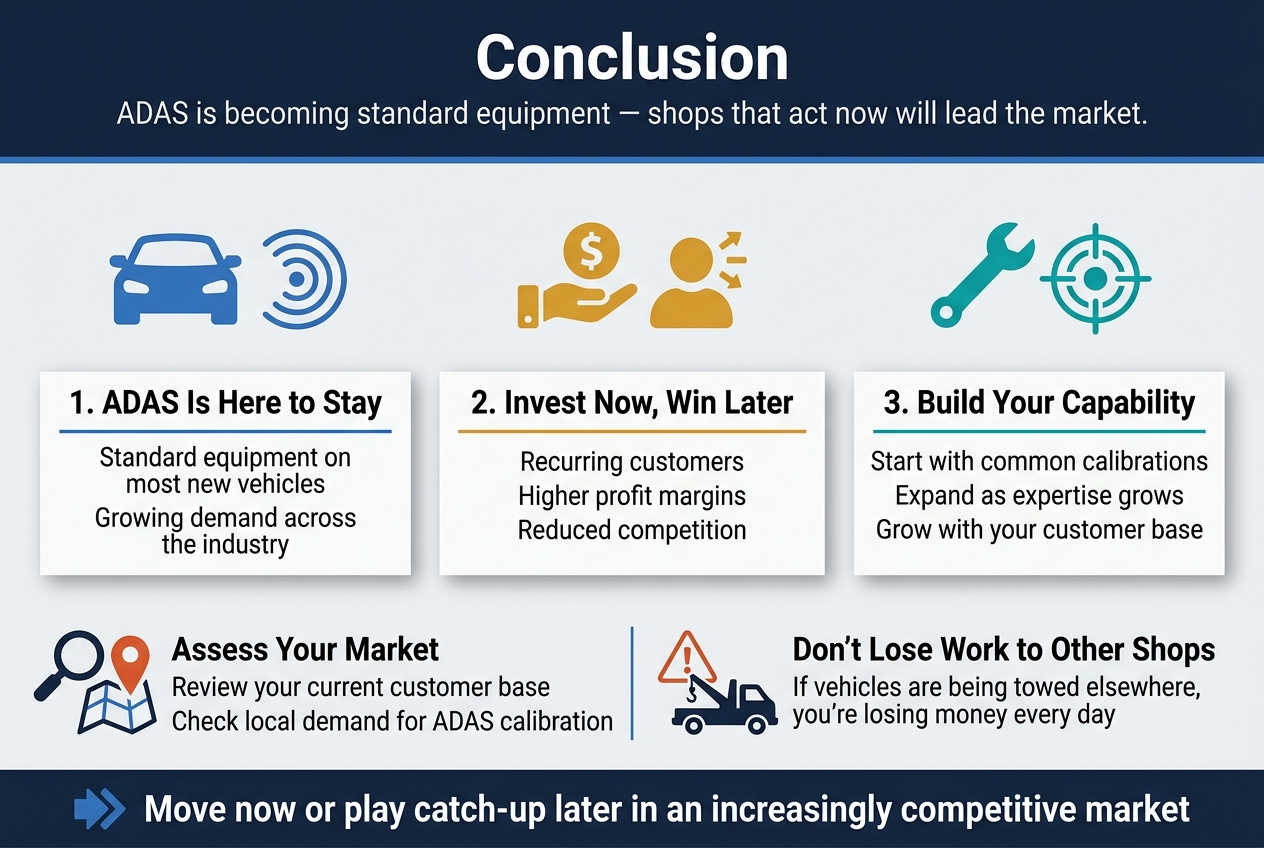
- Growing demand: ADAS is becoming standard on most vehicles, and customers + insurers increasingly expect in-house calibration services
- Strong revenue upside: High-margin jobs ($200–$1,500+) with recurring work from repairs, alignments, and windshield replacements
- High upfront cost: ~$75K–$150K+ for equipment, plus training, facility setup, and ongoing updates
- Operational advantage: Keep work in-house, reduce outsourcing costs, speed up turnaround, and improve customer retention
- Real risks: Liability exposure, fast-changing technology, and competition from dealerships and specialized providers
- Best fit: Makes sense if you already see ADAS work and outsource it today; start small and scale as demand grows
ADAS technology isn't going anywhere – it's becoming standard equipment on most new vehicles hitting the road today. Shops that get ahead of this trend now will position themselves as go-to experts while building a profitable new revenue stream.
Want to discuss further if this is the right choice for your shop? Give us a call at (303) 278-7790 today!