Stop Guessing on Shop Air Compressor
If you've ever had a pneumatic tool sputter mid-job or watched a brand-new compressor struggle to keep up, you already know the pain of a shop air system that wasn't planned right. This guide is for shop owners, mechanics, and fabricators who are tired of making expensive guesses and want a compressed air system that actually works.
We'll walk you through how to calculate your real shop air demand, how to pick the right compressor size without overspending, and how to design a distribution system that delivers consistent pressure to every tool, every time.
No fluff. Just the practical stuff you need to get it right the first time.
Understand Why Compressed Air Systems Are Frequently Mismanaged
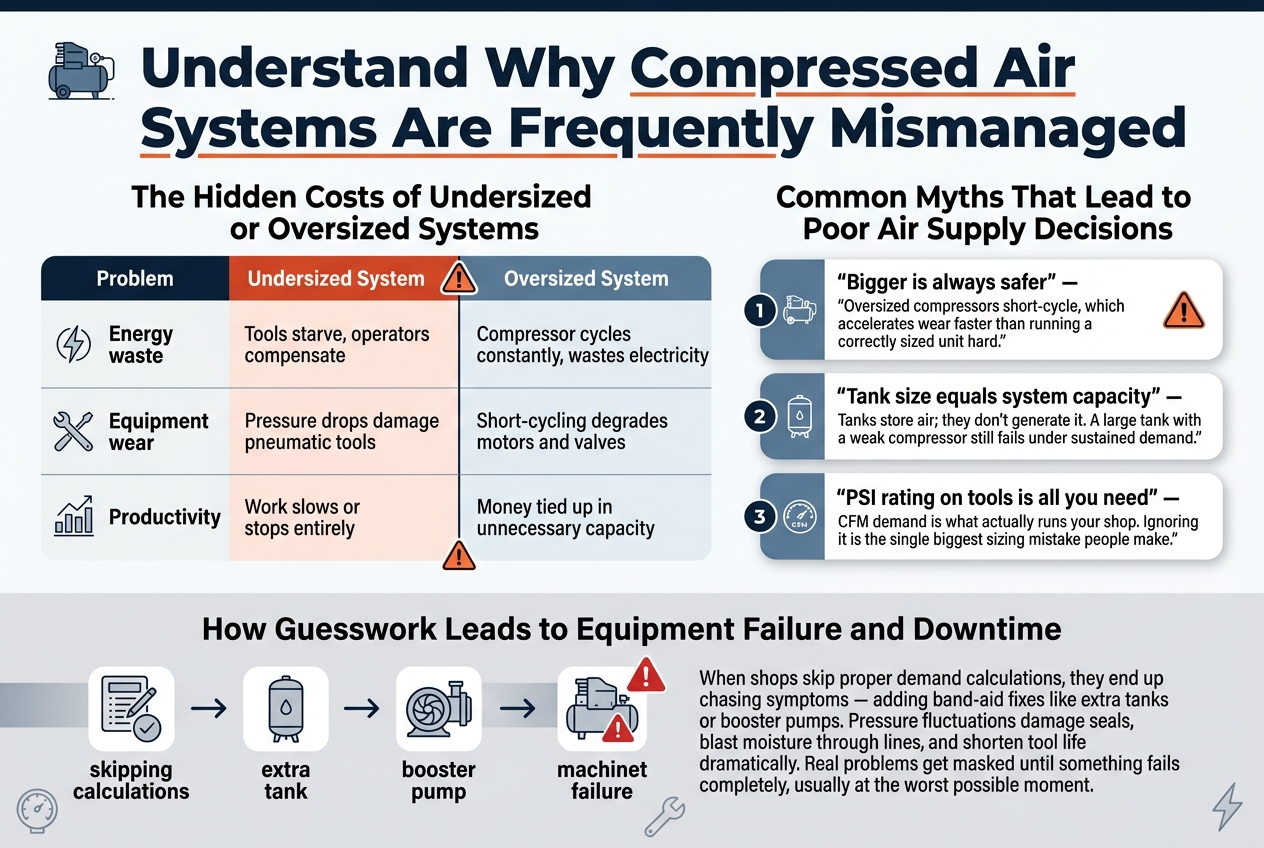
The Hidden Costs of Undersized or Oversized Systems
Getting compressor sizing wrong hits your wallet twice — once upfront, and every day after.
| Problem | Undersized System | Oversized System |
| Energy waste | Tools starve, operators compensate | Compressor cycles constantly, wastes electricity |
| Equipment wear | Pressure drops damage pneumatic tools | Short-cycling degrades motors and valves |
| Productivity | Work slows or stops entirely | Money tied up in unnecessary capacity |
Common Myths That Lead to Poor Air Supply Decisions
- "Bigger is always safer" — Oversized compressors short-cycle, which accelerates wear faster than running a correctly sized unit hard.
- "Tank size equals system capacity" — Tanks store air; they don't generate it. A large tank with a weak compressor still fails under sustained demand.
- "PSI rating on tools is all you need" — CFM demand is what actually runs your shop. Ignoring it is the single biggest sizing mistake people make.
How Guesswork Leads to Equipment Failure and Downtime
When shops skip proper demand calculations, they end up chasing symptoms — adding band-aid fixes like extra tanks or booster pumps. Pressure fluctuations damage seals, blast moisture through lines, and shorten tool life dramatically. Real problems get masked until something fails completely, usually at the worst possible moment.
Calculate Your Actual Shop Air Demand Before Buying
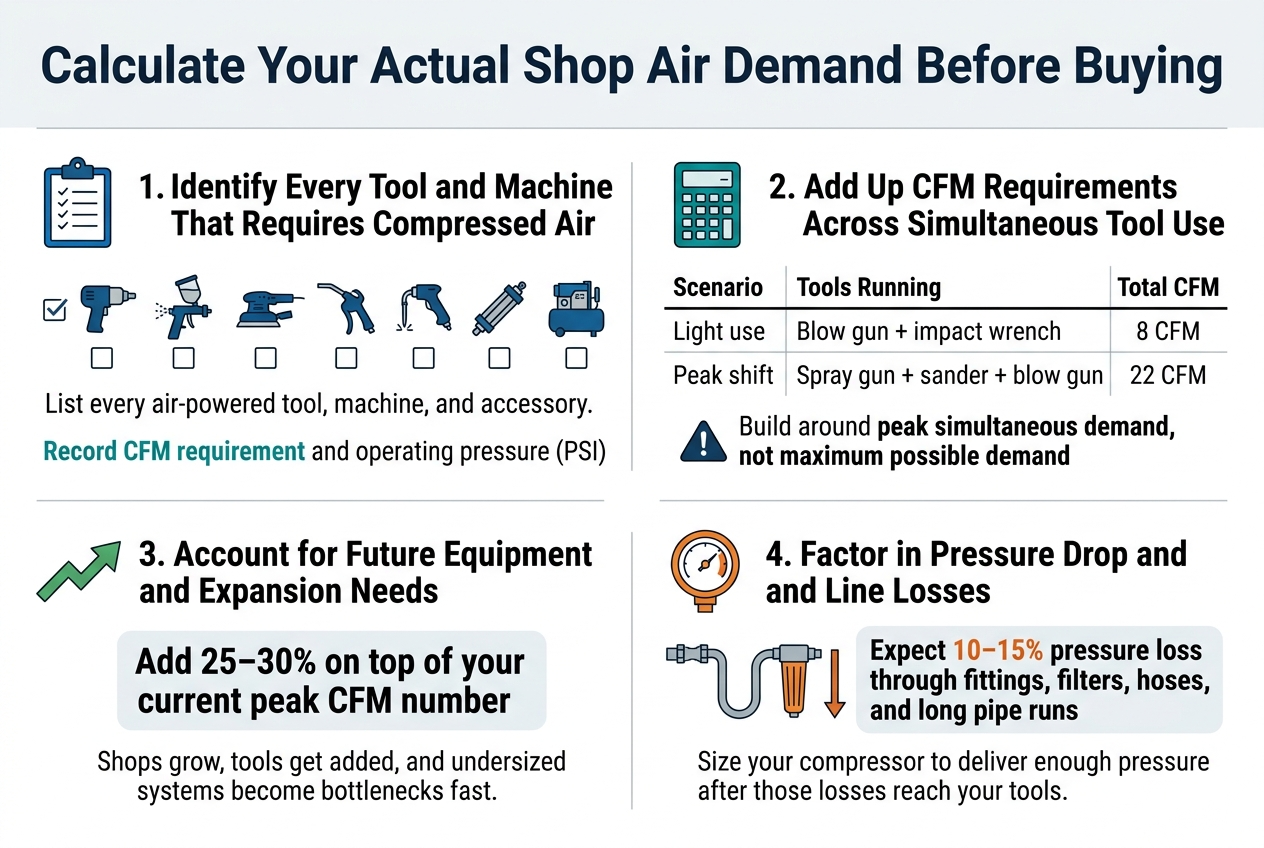
Identify Every Tool and Machine That Requires Compressed Air
Start by walking your shop floor with a clipboard. List every air-powered tool, machine, and accessory — impact wrenches, spray guns, sanders, blow guns, plasma cutters, pneumatic cylinders, and anything else that pulls from the line.
For each item, record its CFM requirement and operating pressure (PSI) from the manufacturer's spec sheet or tool label.
Add Up CFM Requirements Across Simultaneous Tool Use
Don't add every tool's CFM together — that's how you overbuy. Instead, think realistically about what runs at the same time during peak production.
| Scenario | Tools Running | Total CFM |
| Light use | Blow gun + impact wrench | 8 CFM |
| Peak shift | Spray gun + sander + blow gun | 22 CFM |
Build your system around peak simultaneous demand, not maximum possible demand.
Account for Future Equipment and Expansion Needs
Add 25–30% on top of your current peak CFM number. Shops grow, tools get added, and undersized systems become bottlenecks fast.
Factor in Pressure Drop and Line Losses
Expect 10–15% pressure loss through fittings, filters, hoses, and long pipe runs. Size your compressor to deliver enough pressure after those losses reach your tools.
Choose the Right Air Compressor Size for Your Operation
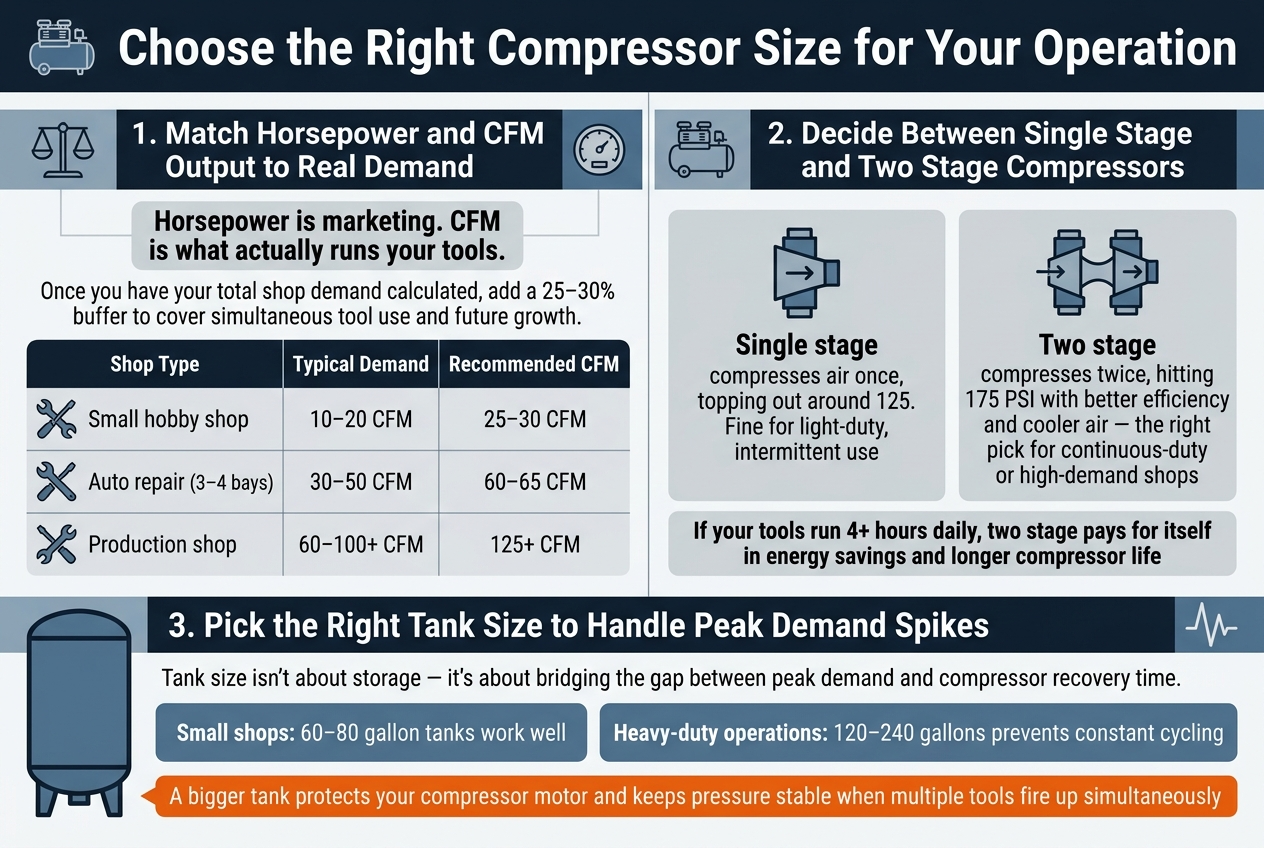
Match Horsepower and CFM Output to Real Demand
Horsepower is marketing. CFM is what actually runs your tools. Once you have your total shop demand calculated, add a 25–30% buffer to cover simultaneous tool use and future growth.
| Shop Type | Typical Demand | Recommended CFM |
| Small hobby shop | 10–20 CFM | 25–30 CFM |
| Auto repair (3–4 bays) | 30–50 CFM | 60–65 CFM |
| Production shop | 60–100+ CFM | 125+ CFM |
Decide Between Single Stage and Two Stage Compressors
- Single stage compresses air once, topping out around 125 PSI. Fine for light-duty, intermittent use
- Two stage compresses twice, hitting 175 PSI with better efficiency and cooler air — the right pick for continuous-duty or high-demand shops
- If your tools run 4+ hours daily, two stage pays for itself in energy savings and longer compressor life
Pick the Right Tank Size to Handle Peak Demand Spikes
Tank size isn't about storage — it's about bridging the gap between peak demand and compressor recovery time.
- Small shops: 60–80 gallon tanks work well
- Heavy-duty operations: 120–240 gallons prevents constant cycling
- A bigger tank protects your compressor motor and keeps pressure stable when multiple tools fire up simultaneously
Design a Shop Air Distribution System That Delivers Results
Use Proper Pipe Sizing to Minimize Pressure Drop
Undersized pipe is one of the biggest silent killers of shop air performance. A good rule of thumb: size your main header to keep velocity under 20 ft/sec and pressure drop under 1 PSI across the entire run.
| Pipe Diameter | Recommended Max Flow (CFM) |
| 3/4" | 25–40 CFM |
| 1" | 50–75 CFM |
| 1-1/4" | 100–150 CFM |
| 1-1/2" | 150–200 CFM |
Select the Right Piping Material for Long Term Reliability
- Aluminum: Lightweight, corrosion-free, and easy to reconfigure — the best all-around choice
- Black iron: Durable but rusts internally, contaminating air and tools
- Copper: Clean and reliable, though more expensive to install
- PVC: Never use it for compressed air — it becomes brittle and can shatter dangerously
Position Drop Lines and Outlets for Maximum Efficiency
Drop lines should come off the top of the main header, not the bottom. This keeps condensate from draining into your tools. Space outlets every 10–15 feet in work areas.
Install Filters, Regulators, and Lubricators at Key Points
Put a filter-regulator-lubricator (FRL) combo at each machine, not just at the compressor. Point-of-use filtration protects tools from moisture and particulates that accumulate in long pipe runs.
Plan for Easy Access and Future Modifications
Run your system in a loop rather than a dead-end layout. Loop systems self-balance pressure and make adding new drops straightforward without disrupting existing connections.
Maintain Your System to Protect Performance and Equipment
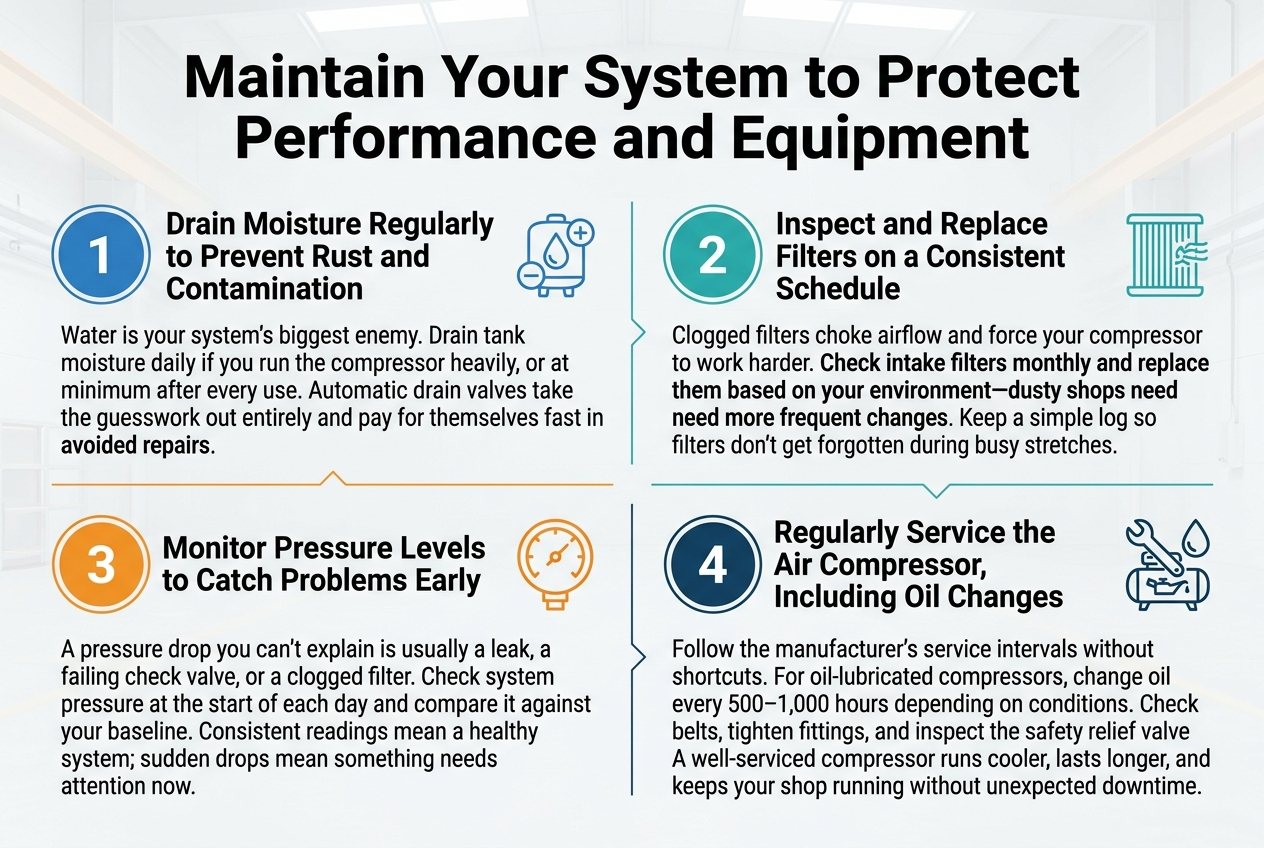
Drain Moisture Regularly to Prevent Rust and Contamination
Water is your system's biggest enemy. Drain tank moisture daily if you run the compressor heavily, or at minimum after every use. Automatic drain valves take the guesswork out entirely and pay for themselves fast in avoided repairs.
Inspect and Replace Filters on a Consistent Schedule
Clogged filters choke airflow and force your compressor to work harder. Check intake filters monthly and replace them based on your environment—dusty shops need more frequent changes. Keep a simple log so filters don't get forgotten during busy stretches.
Monitor Pressure Levels to Catch Problems Early
A pressure drop you can't explain is usually a leak, a failing check valve, or a clogged filter. Check system pressure at the start of each day and compare it against your baseline. Consistent readings mean a healthy system; sudden drops mean something needs attention now.
Regularly Service the Air Compressor, Including Oil Changes
Follow the manufacturer's service intervals without shortcuts. For oil-lubricated compressors, change oil every 500–1,000 hours depending on conditions. Check belts, tighten fittings, and inspect the safety relief valve annually. A well-serviced compressor runs cooler, lasts longer, and keeps your shop running without unexpected downtime.
Measure and Optimize Your System for Ongoing Savings
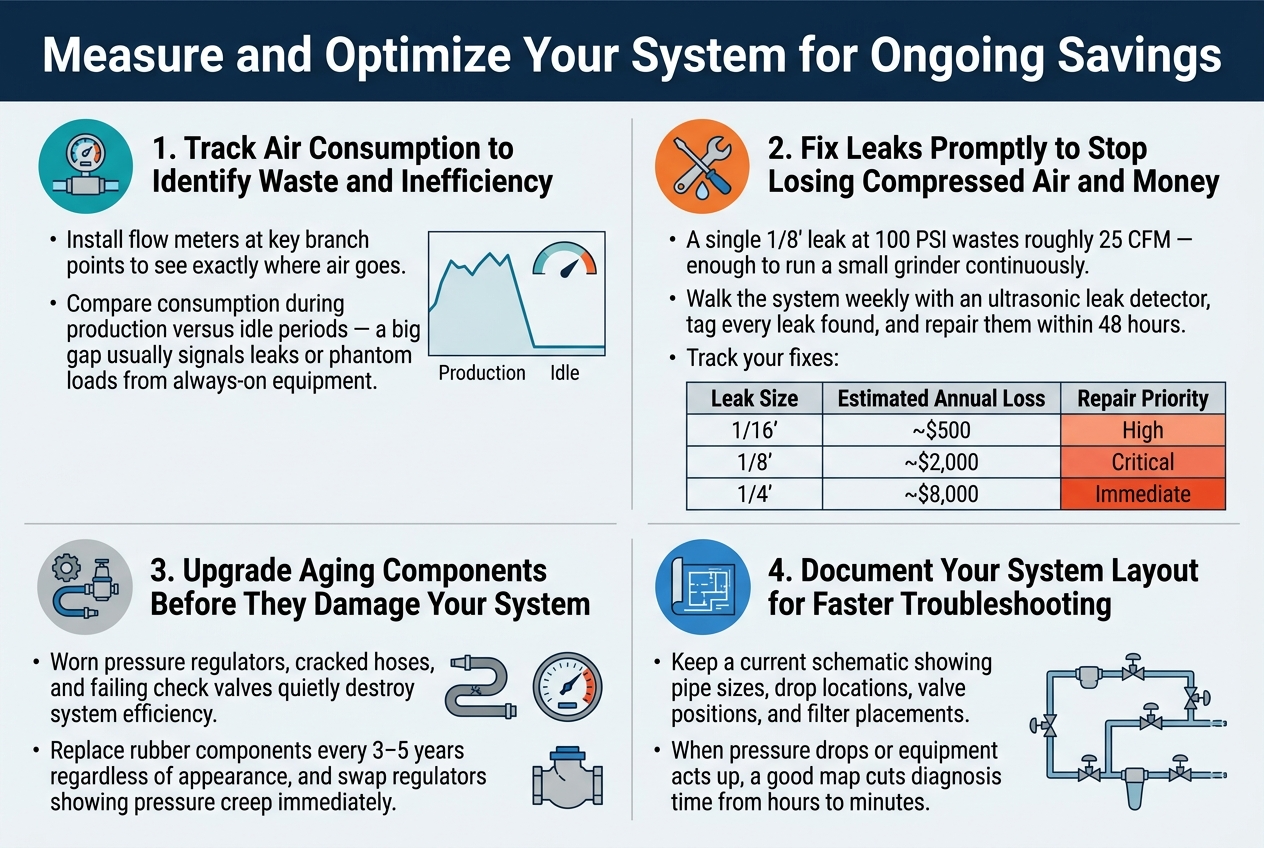
Track Air Consumption to Identify Waste and Inefficiency
Install flow meters at key branch points to see exactly where air goes. Compare consumption during production versus idle periods — a big gap usually signals leaks or phantom loads from always-on equipment.
Fix Leaks Promptly to Stop Losing Compressed Air and Money
A single 1/8" leak at 100 PSI wastes roughly 25 CFM — enough to run a small grinder continuously. Walk the system weekly with an ultrasonic leak detector, tag every leak found, and repair them within 48 hours. Track your fixes:
| Leak Size | Estimated Annual Loss | Repair Priority |
| 1/16" | ~$500 | High |
| 1/8" | ~$2,000 | Critical |
| 1/4" | ~$8,000 | Immediate |
Upgrade Aging Components Before They Damage Your System
Worn pressure regulators, cracked hoses, and failing check valves quietly destroy system efficiency. Replace rubber components every 3–5 years regardless of appearance, and swap regulators showing pressure creep immediately.
Document Your System Layout for Faster Troubleshooting
Keep a current schematic showing pipe sizes, drop locations, valve positions, and filter placements. When pressure drops or equipment acts up, a good map cuts diagnosis time from hours to minutes.
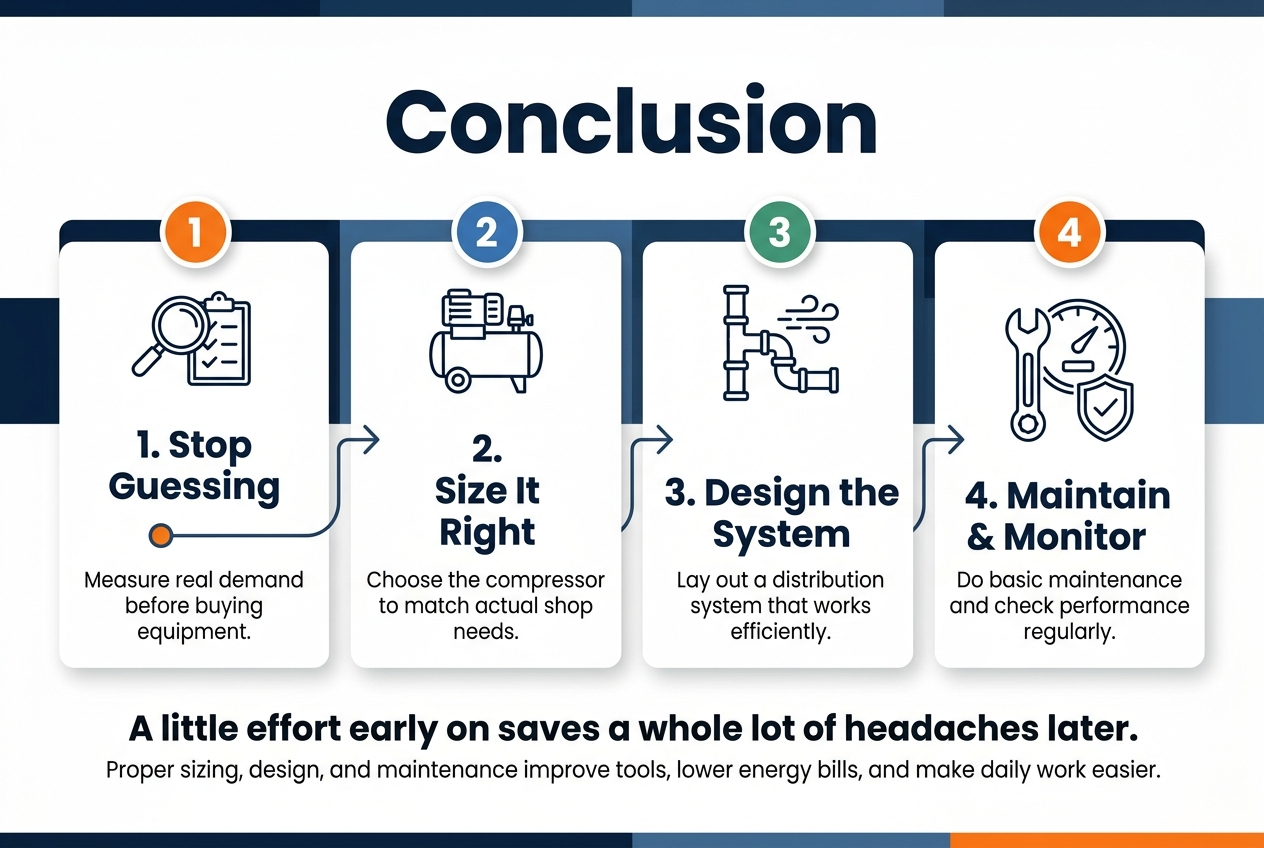
Getting your shop air system right isn't rocket science, but it does take a little more thought than just grabbing the biggest compressor you can afford and hoping for the best. From understanding why so many shops get this wrong in the first place, to calculating real demand, choosing the right compressor size, and laying out a distribution system that actually works — every step matters and builds on the last.
The good news is that once your system is properly sized, designed, and maintained, it largely takes care of itself — and you'll feel the difference in your tools, your energy bills, and your day-to-day workflow. Stop guessing and start measuring. Do the homework upfront, keep up with basic maintenance, and check in on your system's performance every now and then. A little effort early on saves a whole lot of headaches down the road.